
On cricket, maths, tripods and nature

Page 2
The advantage then of cricket is that the player is almost stationary and
does not move very far. The disadvantage is that he (or she by the way,
Let's do some more sums! The stumps are 22 yards apart. The ball is
delivered by a quick bowler at a hand speed of something under 100mph – a
more typical value would be 80mph, representing 120ft/s. The ball slows in
the air to 100ft/s when it bounces; there it is further slowed to about
65ft/s when it has, typically, a further 13 feet to travel to reach the
batsman (this distance varies from almost zero for a full toss to almost
half of the pitch length for a bouncer). The ball takes 0.48 seconds between
leaving the bowler's hand and pitching, then a further 0.22 seconds to reach
the wicket. The diagram shows a plot of the ball trajectory and the position
of the ball is indicated assuming that the motor drive is activated as the
ball leaves the bowler's hand. Four framing rates are shown, only two of
which are actually achievable with current digital SLR cameras. Thus at 5fps
(frames per second) it is quite easy to miss the action completely. Even at
10fps the ball would be imaged at first contact with the ground and then
just before it passes over the stumps (or into the stumps).
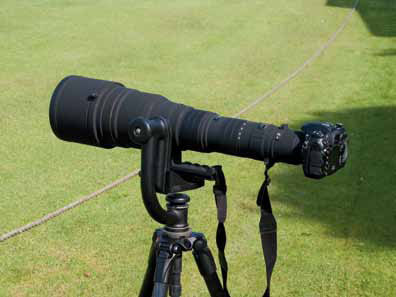
ABOVE: Cricket photography is all about big lenses to bring the action closer. Here an 800mm lens is mounted on the superlative Wimberley counter balanced head on top of the equally sturdy Manfrotto 535 MPro tripod.
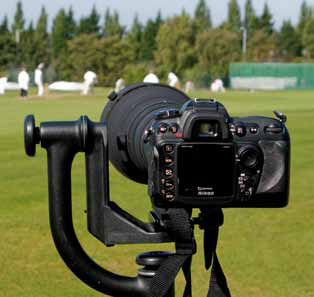
The more detailed shot shows the effect of timing the shutter release to coincide with impact of the ball of the point where the batsman misses the ball and it carries through. The ball is struck about 5 feet from the wicket. At 65 feet/second it will move 6.5 feet between 10 frames-persecond - images, that is about 1½ feet beyond the stumps. However, if the batsman plays on to his own wicket or the ball hits the stumps directly, the second frame is in the bag – there will almost certainly be stuff in the air.
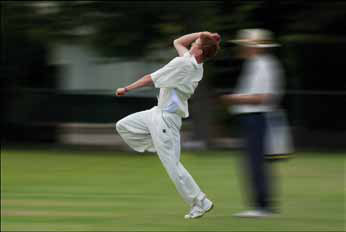
ABOVE Timing is equally important if you are to catch the bowler fully
off the ground.
The outcome of this analysis shows why the timing of the photographer has to
be almost as good as the batsman's if you are to nail bat-toball contact;
but if you do nail that point you are also likely to get the stumps going
down, should that occur, using just two or three frames.
ABOVE You do not have to leave your creative streak in the changing
rooms.
Shooting from 'head-on' solves the issue of the ball disappearing out of
frame but brings with it the likelihood that the batsman may cover your view
of the stumps (at the far end) or the wicket keeper (at the near end). An
advantage of the 'sideon' viewpoint (if available) is that it prevents this
obscuring of your view and also allows you to shoot deliveries from both
ends of the ground. However, you are now vulnerable to outfielders moving
into your field of view; they invariably stand in one location, slightly
away from the batting strip, and then move forward as the bowler starts his
run-up; this is what normally causes them to get in your way just at the
last moment!
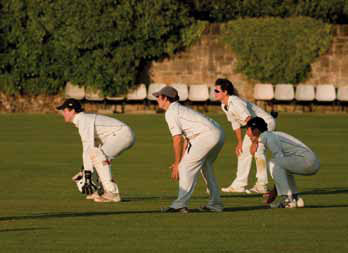
ABOVE Matches can run quite late, offering the long shadows of
these slip fielders and warm light.
Shooting from 'head-on' solves the issue of the ball disappearing out of
frame but brings with it the likelihood that the batsman may cover your view
of the stumps (at the far end) or the wicket keeper (at the near end). An
advantage of the 'sideon' viewpoint (if available) is that it prevents this
obscuring of your view and also allows you to shoot deliveries from both
ends of the ground. However, you are now vulnerable to outfielders moving
into your field of view; they invariably stand in one location, slightly
away from the batting strip, and then move forward as the bowler starts his
run-up; this is what normally causes them to get in your way just at the
last moment!
For all these matters, a knowledge of the game (I am sure our American
readers are almost totally lost by now!) is really useful and a knowledge of
the habits of both batsmen and bowlers also comes in very useful. If you
know for example that a particular bowler always bowls over the wicket you
can change your position slightly as soon as the captain tosses him the ball
(for those unfamiliar with cricket photography, such changes rarely involve
moving more than a couple of yards).
If you are a cricketer, much of the preceding paragraphs will almost be
second nature. Timing, however, is a gift. If you don't believe this go and
look at people playing tennis in the park. The most common fault when people
fail to hit a tennis ball is not getting the racket back early enough so
that the timing can never catch up – the racquet head is never delivered to
the right spot in time, but it is rarely ahead of the position it should be
in. The same mind-set is true for timing a photograph, you have to prepare
to squeeze the shutter and anticipate when impact will occur and time just
slightly ahead of the moment. It is something that comes naturally to people
with timing but is more difficult for people without timing. This is also
why people who are high-class players of one sport are likely to excel at
others, even when they may not reach quite the same dizzy heights as their
primary sport. We can think of Henman (tennis and golf ), Hendry (snooker
and golf ), Hunt (motor racing and Wimbledon) along with a long list of
first-class cricketing golfers. It is all about timing, not raw athleticism.
Nobody would describe John Daly as 'athletic' but he sure can clout a golf
ball!
One piece of good news is that, just as timing improves with practice at
sport, so it does with photography. However, you do need to practise if you
are not naturally gifted and you probably need to go to the warmup games to
get your eye in if you are really serious. This moves us neatly to methods
of improving your eye-to-hand co-ordination and how to increase your chances
of nailing the shot.
The major problem staring down a telephoto lens is the restricted field of
view. A fast bowler starts his run about 40 yards from the batsman. From a
side-on view you are never going to be able to track the ball. It starts at
zero mph, accelerates in the bowler's hand to about 20mph but then, as the
arm comes over the top, the hand speed accelerates to around 80mph while the
body almost stops; and you have to get your lens down the pitch at that
speed – you will never do it! A favourite trick is to open both your eyes
and watch the incoming bowler with the eye that is away from the viewfinder
while watching the batsman through the viewfinder. It is a bit schizophrenic
but it can be done. All you are doing is using the free eye to tell you when
to get ready to shoot, you then normally use the body language of the
batsman to time the shutter release. The batsman from side on is only going
to move slightly towards or away from the camera, usually just enough to
clear his body out of the way to make the stroke. Most of the movement is
either onto the back foot or forward over the front foot. This means you can
manually focus or use autofocus then focus lock before pressing the shutter.
This has the advantage that the lens/camera does not 'see' the gap in front
or behind the batsman and focus on the hedge 140 yards across the pitch.
Tripod matters – holding the brute up Local cricket matches (and indeed Test
matches) start around 11 or 12am and can go on until early evening, seven
hours is reasonably normal. Only heroes can hold a 600mm or 800mm lens for
that length of time and very few people can hold steady with such a weight.
A tripod is better than a monopod for comfort – this is cricket remember and
the batsman is always close to his crease, rather than all about the pitch.
For soccer or rugby the additional mobility of a monopod is far better. We
have been reviewing the Manfrotto 535 Pro tripod paired up with the
Wimberley head. Although the Wimberley is rightly famous with bird
photographers it works superbly for cricket. The nicest thing was that the
head could be levelled with the Manfrotto ball-support so that the rotation
about the vertical axis was 'true', enabling smooth tracking of the batsman
as he moved forwards and backwards. When the lock-wheel pinches tight it
does so without the annoying rotational shift that you get with other heads
which is enough on an ultra-telephoto to remove the subject from the frame
completely! Because the counterbalance of the head is so light we were also
able to track the lofted ball all the way to the catcher (only to have a
stray fielder step right in front of our field of view at the last moment).
See the full feature on tripods next.
In common with modern design, the leg hinge allows three positions for
low-level shooting, namely 16 inches, 24 inches and 30 inches each with an
ability to claim an additional seven inches by extending the centre column.
Fully extended, the base of a camera would stand at 65 inches off the
ground.
The legs are extended by releasing the snap action clasp which was secure
during use with or without gloved hands to operate it. The three section
arrangement carries the penalty of a longer unit when collapsed down. Fully
closed it was longer than the largest LowePro bag favoured by Paul
Gallagher.
Manfrotto 535 MPRO
We asked to review this tripod following advice from Bogen's Vic Solomon at
the Rutland Bird Fair. Intended for use with ultra-telephoto lenses, we
accepted the weight of the 34mm diameter legs but the use of carbon fibre
did reduce this to a minimum. The unit carries a 75mm ball socket to which
your chosen head is attached. This is a gem of a feature as we wished to add
a Wimberley head and it could be levelled off reasonably easily (if
manoeuvring an 800mm lens is ever easy!). You slacken the rubber stem
underneath the tripod and roll the head into position until it is level.
Providing you do this with some care the Wimberley will move and maintain a
constant horizon as you track, say, a moving bird. Like the Giotto the
hinges allow for three low-level positions, namely: 11, 20 and 27 inches to
the bottom of the head.
The tripod weight (5.1lb; 92.3kg), has a maximum rated load of 44lb and a
folded length of 29 inches. It was provided in the natty 'quiver' opening
carry bag which is useful if you tend to throw your gear about in the back
of an estate car.
In use we found the entire set-up just about manageable. It weighed in at
22lb which is the weight of a small child. This was carried for four hours
over a cross-country route of about 4 miles. After that length of time the
34mm leg resting on the shoulder felt like a pointed scalpel – the things we
do for you, dear reader (and next time we will be wearing the powerlunch
shoulder pads Posh Spice has promised us, failing that look at the Stealth
Gear review in this issue). For somebody of your editor's stature (think
small!) the reach to the first locking clasp is a little too far. The tripod
was never used with the second leg at any stage, two sections were always
high enough.
Page 1 -
Page 2 - Page 3
Join The Society of International Sport & Leisure Photographers today!

Society of International Sport & Leisure Photographers (SISLP) is a trading name of BPPA Ltd
Clwyd Chambers, Clwyd Street, Rhyl, Denbighshire, LL18 3LA, UK
BPPA Ltd Company Reg 0392 2894
VAT number 790 4289 05
Tel: 01745 356935
Corporate Partners





Newsletter
Subscribe to the Societies Newsletter. Subscribe here.
Privacy - London Photography & Video Show - Europe's Largest 'All-Welcome' Photographic Convention
Update cookies preferences